

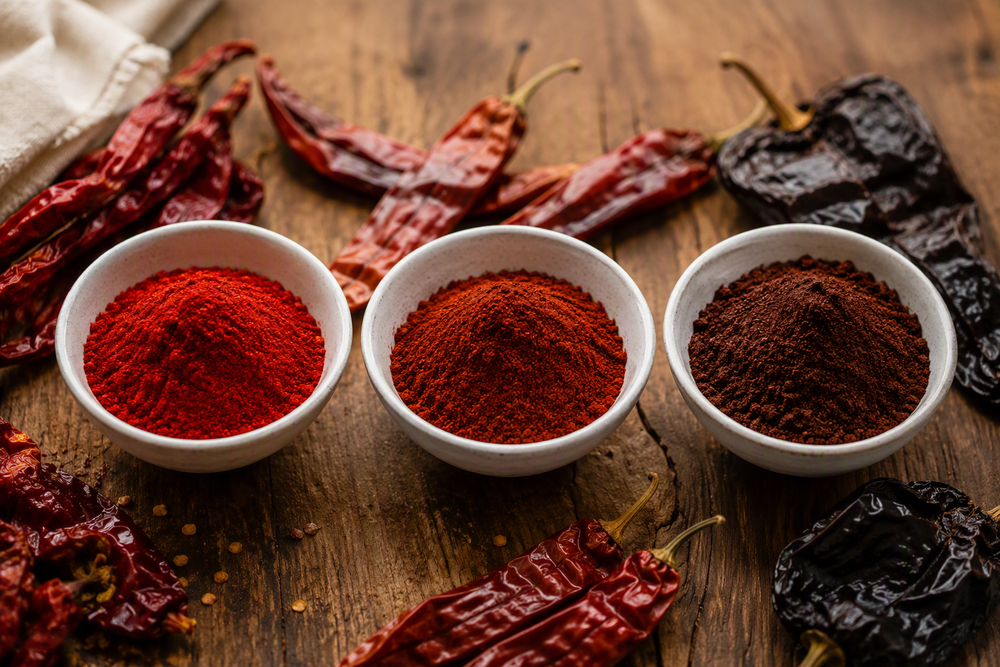
Quick answer: these three red chile powders all sit in the mild-to-medium band and all are famous for color, but they taste different and belong to different cuisines. Kashmiri (fruity, vivid red; our batch lab-tests at a medium 14,070 SHU) is the Indian restaurant chili behind butter chicken; New Mexico chile (earthy, sweet, brick red) is the Southwestern sauce chili; ancho (raisin-sweet, dark) is dried poblano for moles and adobos. If you cook Indian food, Kashmiri is the one to keep stocked. From Byadgi's single-origin Kashmiri is lab tested, one ingredient, and the deepest red of the three.
Search data shows thousands of US cooks comparing red chile powders every month, and it is easy to see why: the jars look alike, the names overlap (chile, chili, chilli), and every cuisine claims its own "best mild red chili." Here is the honest side-by-side, including when each one wins.
Meet the three contenders
Kashmiri chili powder comes from Kashmir in northern India. It is the color king of Indian cooking: mild heat, fruity flavor, and a red so vivid that restaurant kitchens use it by the spoonful to make butter chicken, tikka masala, rogan josh and tandoori marinades glow. Generic Kashmiri is famously mild (around 1,000 to 2,000 SHU), but heat varies by farm and batch: our single-origin lot lab-tests at a solid medium 14,070 SHU, with the certificate published on our lab results page. Whatever brand you buy, the COA is the number to trust.
New Mexico chile powder comes from New Mexican pod-type chilies, the backbone of Southwestern cooking. When it is grown in the Hatch Valley it is sold as Hatch chile powder. Flavor is earthy, slightly sweet, with a gentle-to-medium heat depending on the variety, and the color runs brick red rather than crimson. This is the chili of red chile sauce, enchiladas, posole and chili con carne.
Ancho chile powder is simply dried, ripe poblano peppers ground up. Mild (1,000 to 2,000 Scoville units), dark red-brown, and distinctly fruity in a dried-fruit way: think raisins, prunes, a hint of cocoa and coffee. Ancho is the base note of moles, adobos and many Mexican braises.
The side-by-side
| Kashmiri | New Mexico / Hatch | Ancho | |
|---|---|---|---|
| What it is | Ground Kashmiri chilies | Ground New Mexican chilies | Ground dried poblanos |
| Heat | Medium (variety is famously mild; our batch lab-tests 14,070 SHU) | Mild to medium (varies, often 1,500-4,000 SHU) | Mild (1,000-2,000 SHU) |
| Color | Deep vivid red | Brick red | Dark red-brown |
| Flavor | Fruity, bright, lightly smoky | Earthy, sweet, sun-dried | Raisin, prune, cocoa |
| Signature dishes | Butter chicken, tikka masala, rogan josh | Red chile sauce, enchiladas, posole, chili con carne | Mole, adobo, birria, braises |
| One ingredient? | Yes, when single-origin like ours | Yes, when pure (check labels) | Yes, when pure |
Can you swap them for each other?
Partially. All three are mild and red, so in a pinch they cover each other's color job, but the flavors pull in different directions:
- Kashmiri for New Mexico or ancho: works for color in chili con carne, taco meat and bean dishes, and adds a brighter fruitiness. The dish will taste a little less earthy, a little more vivid. Start with the same amount, keeping in mind our Kashmiri runs hotter than most New Mexico and ancho powders, so taste as you go.
- New Mexico or ancho for Kashmiri: the weakest direction. You keep the mildness but lose the vivid red payoff that is the whole point of Kashmiri in Indian food. Butter chicken made with ancho tastes fine but looks muddy compared to the restaurant glow.
- Blending them: some cooks run Kashmiri plus ancho in braises for color plus dark fruitiness. It works surprisingly well in chili con carne and barbecue rubs.
Which one belongs in your pantry?
Match the chili to the cuisine you cook most. Southwestern and Mexican food three nights a week? New Mexico chile powder and ancho earn their shelf space. Indian food, or you chase that restaurant-red color in curries, marinades and even non-Indian dishes like roasted vegetables and creamy soups? Kashmiri is the daily driver, and it doubles as the best paprika upgrade in the rack.
If Kashmiri is your pick, quality shows in two places: purity and testing. Our From Byadgi Kashmiri chili powder is single-origin, one ingredient (no blends, no fillers), and every batch is third-party lab tested with results published on our lab results page. Want more color with more kick? Byadgi chili powder is Kashmiri's deeper, hotter cousin from Karnataka, used at about half the quantity. And if this is your first Kashmiri purchase, the substitutes guide shows exactly where it fits among the swaps.
FAQ: red chile powders compared
Is Kashmiri chili powder the same as New Mexico chile powder?
No. Kashmiri comes from Kashmir, India and tastes fruity and bright with a vivid red color. New Mexico chile powder comes from New Mexican chilies and tastes earthier and sweeter with a brick-red color. Both are mild, but they belong to different cuisines.
Is ancho chili powder the same as chili powder?
Ancho is one single ingredient: ground dried poblano peppers. American "chili powder" is usually a blend of chilies with cumin, garlic and oregano. Ancho is a component; the blend is a seasoning mix.
Which is hotter, Kashmiri or New Mexico chile?
On paper, New Mexico chile powder: generic Kashmiri runs 1,000 to 2,000 Scoville units, while New Mexico varieties often run 1,500 to 4,000 depending on the type. But batch matters more than variety: our Kashmiri lab-tests at 14,070 SHU, hotter than most New Mexico chile powders, so check the COA. Hatch chile powders can be mild or medium, so check the label.
Can I use Kashmiri instead of ancho in mole?
You can for color and mild warmth, but you will miss ancho's raisin-and-cocoa depth, which is central to mole's flavor. Better to keep ancho for moles and use Kashmiri where bright red color is the goal.
What is the difference between Hatch and New Mexico chile powder?
Hatch chiles are New Mexican chile varieties grown in the Hatch Valley of New Mexico, a bit like Champagne versus sparkling wine. All Hatch chile powder is New Mexico chile powder, but not all New Mexico chile powder is from Hatch.
 Paprika vs Chili Powder: The Real Difference and Best Swap
 Kashmiri Mirch, Degi Mirch, Cashmere Chili: Same Thing?