
Heavy metals
✓ PASS










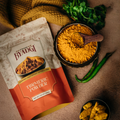
Also known as haldi — the golden heart of every Indian kitchen
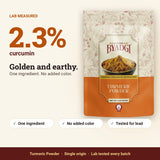
Golden, earthy, slightly bitter. Colour, flavour, and ancient wellness.
 Third-party lab tested · every batch✓ Same-day shipping on orders by 2 pm PT (Mon–Fri)✓ Free U.S. shipping over $36✓ 30-day money-back guarantee✓ Non-GMO Project Verified
Batch TP004 · Report BARC-26-09-11066 · Tested September 2026
Tested by our NABL-accredited lab partner in India against FSSR 2011 standards. ✓ PASS means the result is within the safe limit. Exact numbers are in the full report.
Read the full report (PDF) →
Add ¼–½ tsp to hot oil or ghee early in cooking. For rice, ¼ tsp per cup gives a soft golden color.
Simmer ½ tsp in a cup of warm milk with a pinch of black pepper, then sweeten with honey or jaggery.
A pinch in scrambled eggs, lentil soup or tossed with vegetables before roasting adds color and a warm, earthy note.
Most turmeric on shelves is pale, stale, and stretched with fillers. Here's how we're different.
| From Byadgi | Typical store turmeric | |
|---|---|---|
| Color | Deep golden-yellow, 2.3% curcumin in our lab test | Often pale and dull after months on the shelf |
| Freshness | Manufacturing date printed on every pouch | Usually only a best-by date |
| Cost | $10.67 per 100 g at regular price, for tested, traceable turmeric | Often cheaper per ounce, but with no testing or source shown |
| Lab testing | 105 tests per batch: pesticides, heavy metals, aflatoxins, salmonella, E. coli | Results rarely shared |
| What's inside | One ingredient: turmeric. Nothing else. | May contain fillers, starch or yellow dye |
| Full transparency | Batch number, manufacturing date and lab report (QR code) on every pouch, from a family 40 years in the trade | Little beyond the label; often unclear who packed it or where |
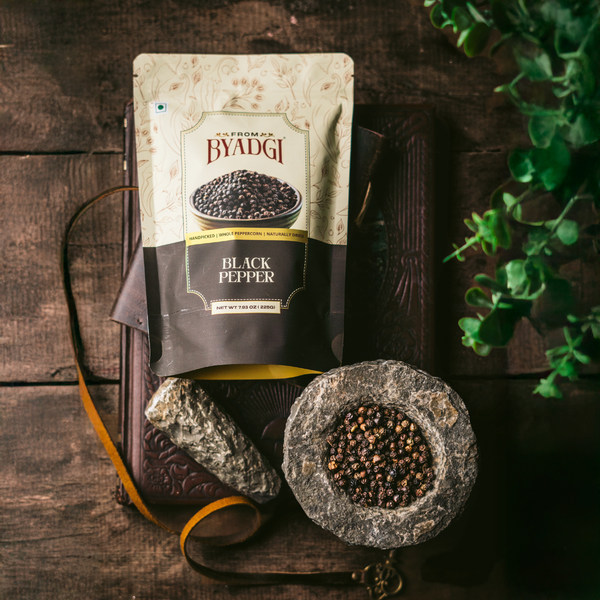
It's the classic pairing — in Indian kitchens, haldi and black pepper go together, and a pinch of pepper is the traditional finishing touch in golden milk and curries. If you need some, our whole Black Peppercorns are lab tested too.
Yes — that's exactly what it's for. Simmer ½ tsp with a cup of warm milk (dairy or oat), a pinch of black pepper, and honey or jaggery to taste. Golden, earthy, done in five minutes.
Color hints at freshness, but it isn't proof — adulterated turmeric can be dyed brighter (that's the lead chromate problem in cheap supply chains). The only real proof is a lab report: ours is published, 105 parameters, every batch.
Yes — every batch is third-party lab tested across 105 parameters before packing, and the reports are published on our Lab Results page. Each pouch carries its manufacturing date too.
Big bulk bags sit in warehouses for months and carry no manufacturing date and no published per-batch lab report — you can't verify purity or freshness. Every From Byadgi pouch is freshly milled with the date printed on it and a published 105-parameter lab report, backed by a money-back guarantee from a family you can actually reach.
Turmeric is one of the most versatile spices in the kitchen. Use it in dal, curries, rice, soups, stews, scrambled eggs, roasted vegetables, smoothies, golden milk, and marinades. Start with ¼ to ½ teaspoon per dish — a little goes a long way. Once you start adding it, you'll wonder how you cooked without it.
You can use it either way. Cooking turmeric in oil or fat helps release its flavor and color into the dish — which is why most Indian recipes add it early to hot oil. But you can also stir it into warm milk, smoothies, or dressings without cooking. Adding a pinch of black pepper alongside turmeric is a common Indian kitchen practice.
Turmeric stains — that's actually a sign it's pure and potent. A few tips: use stainless steel or dark-colored utensils, wipe up spills immediately with soap and water, and keep a dedicated wooden spoon for turmeric dishes. For hands, rub with lemon juice or oil after cooking. The staining is worth it for the color it gives your food.
For most curries and dals: ¼ to ½ teaspoon. For rice: ¼ teaspoon per cup of rice. For golden milk: ½ to 1 teaspoon per cup. For marinades: ½ to 1 teaspoon mixed into yogurt. Start small — fresh turmeric like ours is more potent than stale grocery store powder, so you may need less than you're used to.
We're a family from Byadgi, Karnataka — with over 40 years in the spice business. Three retail shops, a wholesale network, and end-to-end control from sourcing to delivery. Every batch is hand-selected, third-party lab tested, and Non-GMO verified.
Keep in the original sealed pouch or transfer to an airtight container. Store in a cool, dark place — not above your stove. Always use a dry spoon. Best within 12 months of the manufacturing date printed on the pouch for the fullest color and aroma. Stored well, it keeps nicely beyond that, and many of our customers use it longer.
Free shipping on all U.S. orders over $36. Orders placed by 2 pm PT (Mon–Fri) ship the same day, with full tracking.
You're covered by our 30-day money-back guarantee. If the spices don't meet your expectations or arrive damaged, email us and we'll refund or replace them. We're a family business — your trust means everything to us.

 Bestseller
 Bestseller
 Ships free
 Diwali gift